



Choosing the best oil & gas software in 2026 depends on your operation. Petrel is better suited to reservoir modeling, Quorum to upstream workflows, AVEVA to engineering and digital twins, IFS to asset management, and SAP to large enterprise operations.
Oil and gas companies need software for production, field operations, accounting, assets, compliance and engineering, so no single platform fits every business. In this guide, we compare 10 leading oil and gas software solutions by features, use case, deployment, integrations and overall fit to help you choose the right one.
Best Oil & Gas Software in 2026: Quick Comparison
| Software | Best For | Key Strength | Deployment | Pricing |
|---|---|---|---|---|
| SafetyCulture | HSE & field inspections | Inspections and operational workflows | Cloud/mobile | Free and paid options |
| AVEVA | Engineering & digital twins | Engineering and industrial intelligence | Cloud/hybrid ecosystem | Contact vendor |
| Quorum | Upstream operations | Integrated upstream workflows | Cloud/SaaS | Contact vendor |
| Enertia | Oil & gas ERP | Energy-focused ERP workflows | Enterprise | Contact vendor |
| IFS | Asset-intensive operations | Asset lifecycle management | Cloud/enterprise | Contact vendor |
| SAP | Large enterprises | ERP and enterprise operations | Cloud/on-premise options | Contact vendor |
| FieldCap | Oilfield services | Field tickets and workflow management | Cloud/mobile | Contact vendor |
| Petrel | Reservoir engineering | Subsurface modeling | Enterprise | Contact vendor |
| Ambyint | Production optimization | AI-powered well optimization | Cloud | Contact vendor |
| GreaseBook | Independent operators | Field production management | Mobile/cloud | Contact vendor |
What Is Oil & Gas Software?
For those who don’t know oil & gas software is specialized technology used to manage technical, operational and business processes across the oil and gas value chain. Depending on the application, it can handle exploration, reservoir modeling, production, field operations, asset maintenance, accounting, land management, pipelines, engineering, compliance or enterprise resource planning.
The term therefore describes a software category rather than one specific type of application.
A petroleum engineer using reservoir simulation software has different requirements from an accountant using an oil and gas ERP, even though both products fall under the broader oil and gas software category.
10 Oil & Gas Software Solutions of 2026
Oil and gas software covers several fundamentally different categories, so ranking platforms purely by the number of features would be misleading. We evaluated the platforms based on their oil and gas specialization, core operational capabilities, target users, field accessibility, data and analytics capabilities, integrations, deployment options, scalability and overall fit for their intended use case.
Following are the 10 best oil & gas softwares evaluated in 2026.
1. SafetyCulture
SafetyCulture takes a different approach from traditional oil and gas ERP software. Its strength is digitizing frontline workflows such as inspections, issue reporting, safety processes and operational checks.
For oilfield teams still relying on paper forms, spreadsheets or disconnected inspection records, moving those processes into a mobile environment can improve visibility between field teams and management.
Key Features
- Digital inspections and checklists
- Issue and incident reporting
- Mobile field access
- Corrective actions
- Operational reporting
- Training capabilities
- Team and permission management
Pros
- Easier to deploy than large ERP platforms
- Strong mobile focus
- Suitable for safety and field workflows
- Useful across multiple locations
Cons
- Not a full oil & gas ERP
- Doesn’t replace specialized reservoir software
- Advanced requirements may require integrations with other systems
Pricing
SafetyCulture offers free access alongside paid tiers; organizations should check current plans and limits directly before deployment.
2. AVEVA
AVEVA is one of the strongest options in this comparison for complex industrial engineering and operations.
Its oil and gas solutions cover multiple parts of the value chain, including upstream operations, LNG, pipelines, gas processing and downstream environments. AVEVA also combines engineering information, operational data, analytics and visualization to support digital-twin environments.
A digital twin connects a physical asset or process with engineering information and operational data, helping teams monitor performance, investigate scenarios and make better-informed operational decisions.
Key Features
- Engineering data management
- Industrial data infrastructure
- Digital twins
- Real-time operational monitoring
- Advanced visualization
- Asset information management
- Analytics
- Production and process optimization
Pros
- Deep industrial specialization
- Suitable for complex engineering environments
- Broad oil and gas value-chain coverage
- Strong operational-data capabilities
Cons
- More complex than lightweight oilfield applications
- May require substantial implementation and integration
- Overkill for very small operators
Pricing
Enterprise pricing is generally quote-based depending on products, deployment and requirements.
3. Quorum
Quorum is one of the most directly oil-and-gas-focused platforms in this comparison. Its upstream suite connects field and office workflows covering daily well operations, SCADA, field data capture, production allocations, land management, revenue and cost accounting, AFE management and document management. Quorum describes the platform as cloud-powered SaaS built specifically for oil and gas operators.
That breadth makes Quorum particularly interesting for operators trying to replace several disconnected upstream applications.
Key Features
- Production operations
- Field data capture
- Production allocation
- SCADA connectivity
- Land management
- Revenue and cost accounting
- AFE management
- Data APIs
Pros
- Purpose-built for oil and gas
- Broad upstream coverage
- Connects operational and financial workflows
- Cloud-based architecture
Cons
- Can be more platform than small operators require
- Pricing requires vendor consultation
- Implementation requirements depend heavily on modules selected
Pricing
Contact Quorum for a customized quote.
4. Enertia
Enertia occupies an important position between specialized operational tools and broad enterprise ERP platforms. Rather than being designed for every industry, it focuses on energy-sector business processes. That can be valuable for operators that want accounting, land, production and other back-office workflows connected without adapting a generic ERP to every oilfield requirement.
Key Features
- Oil and gas accounting
- Production management
- Land management
- Revenue workflows
- Financial management
- Operational reporting
- Integrated enterprise data
Pros
- Energy-focused ERP approach
- Combines operational and financial processes
- Reduces reliance on disconnected business systems
Cons
- More complex than standalone accounting software
- Pricing isn’t as transparent as consumer SaaS
- May be excessive for small operators with basic needs
Pricing
Pricing is generally provided according to the organization’s requirements and implementation scope.
5. IFS
For companies searching specifically for IFS oil and gas software, the reason it appears frequently in this category is its strength in asset-intensive operations. IFS says its oil and gas platform connects operations, asset maintenance and projects, while its upstream offering extends from field operations through financial processes. Its EAM capabilities cover the asset lifecycle from design through decommissioning.
That makes it especially relevant where physical asset reliability is a central business requirement.
Key Features
- Enterprise asset management
- Asset lifecycle management
- Maintenance
- Field operations
- Project management
- Financial processes
- Industrial AI and analytics
- Resource planning
Pros
- Strong EAM capabilities
- Built for asset-intensive environments
- Covers onshore and offshore operations
- Combines assets, projects and enterprise processes
Cons
- Enterprise implementation
- Too complex for businesses needing only basic field reporting
- Pricing requires consultation
Pricing
IFS provides enterprise pricing based on the required products and deployment.
6. SAP S/4HANA
SAP operates at a different level from smaller oilfield applications. Its oil, gas and energy solutions cover business areas including planning and sourcing, integrated operations, finance, service and human capital management. SAP also supports industry-specific upstream processes and Production and Revenue Accounting.
This makes SAP particularly relevant to large organizations that need oil and gas workflows connected with a much broader enterprise technology environment.
Key Features
- Enterprise resource planning
- Finance and accounting
- Procurement
- Supply chain
- Production and revenue accounting
- Hydrocarbon-related processes
- Enterprise analytics
- Business AI capabilities
Pros
- Extensive enterprise capabilities
- Suitable for large and multinational organizations
- Integrates financial and operational processes
- Industry-specific oil and gas functionality
Cons
- Significant implementation requirements
- Can be unnecessarily complex for small operators
- Requires experienced implementation resources
Pricing
SAP enterprise pricing depends on products, licensing, users and deployment. Some industry functionality can require separate licensing.
7. FieldCap
FieldCap solves a more specific problem. Instead of trying to become a giant oil and gas ERP, it focuses on the workflows of oilfield service businesses.
The platform is built around managing jobs, field tickets, billing and communication between field teams and the office. FieldCap also supports offline use and lists workflows across well services, pipelines, inspections, equipment rentals, drilling, hauling, maintenance and other oilfield activities.
Key Features
- Digital field tickets
- Job management
- Billing workflows
- Mobile access
- Offline operation
- Custom workflows
- Field-to-office data flow
Pros
- 100% oilfield-focused positioning
- Practical for field crews
- Offline capabilities
- Reduces paper ticket workflows
Cons
- Not designed as reservoir engineering software
- Doesn’t replace a full enterprise ERP
- Best suited to service-oriented operations
Pricing
FieldCap provides demos and pricing directly based on customer requirements.
8. Petrel
Petrel from SLB is fundamentally different from accounting, ERP and field-service platforms. It’s a subsurface software environment for engineers and geoscientists. Petrel integrates static and dynamic subsurface data to support reservoir characterization, development planning, production evaluation and reservoir performance optimization.
Its reservoir engineering environment can incorporate geological models, fluid properties, historical production data, completions, well models and development scenarios before connecting simulation workflows with reservoir simulators.
Key Features
- Geological modeling
- Geophysics workflows
- Reservoir characterization
- Reservoir engineering
- Production evaluation
- 3D visualization
- Development planning
- Simulation workflows
Pros
- Highly specialized subsurface platform
- Strong reservoir engineering capabilities
- Integrated geological and engineering environment
- Suitable for sophisticated E&P workflows
Cons
- Specialized learning requirements
- Not intended as general ERP software
- Far more advanced than what basic field operations require
Pricing
SLB provides enterprise licensing information according to product and deployment requirements.
9. Ambyint
Ambyint represents the AI-focused side of modern oil and gas software.
Its technology is designed to monitor well behavior and optimize production using physics-informed models and AI. Unlike software that only reports operating data, Ambyint focuses on turning that data into optimization recommendations or automated adjustments within defined operational parameters.
Implementation involves connecting available operational data, including existing SCADA environments and well information.
Key Features
- AI-powered production optimization
- Well performance monitoring
- Automated optimization
- Anomaly identification
- Production recommendations
- SCADA/data integration
- Portfolio-level optimization
Pros
- Highly focused use of AI
- Designed specifically around production
- Can complement existing operational systems
- Supports large well portfolios
Cons
- Doesn’t replace ERP or accounting platforms
- Value depends on available operational data
- Specialized use case
Pricing
Contact Ambyint for pricing based on deployment and operational requirements.
10. GreaseBook
GreaseBook is aimed much more directly at independent operators than the giant enterprise suites on this list. Its approach centers on getting production information from the field into the office quickly and reducing reliance on paper gauge sheets, spreadsheets and disconnected communication.
That makes it an interesting alternative for smaller and mid-sized operators that don’t need the implementation footprint of SAP or a broad engineering platform.
Key Features
- Mobile production data capture
- Oilfield production tracking
- Field-to-office reporting
- Production monitoring
- Operator-focused workflows
- Mobile access
Pros
- Designed around independent operators
- Field-friendly approach
- Narrower learning curve than enterprise suites
- Focused on practical production workflows
Cons
- Doesn’t replace enterprise ERP
- Not a reservoir modeling platform
- Large organizations may require broader systems and integrations
Pricing
Pricing should be confirmed directly with the vendor based on the size and requirements of the operation.
How to Choose the Right Oil & Gas Software
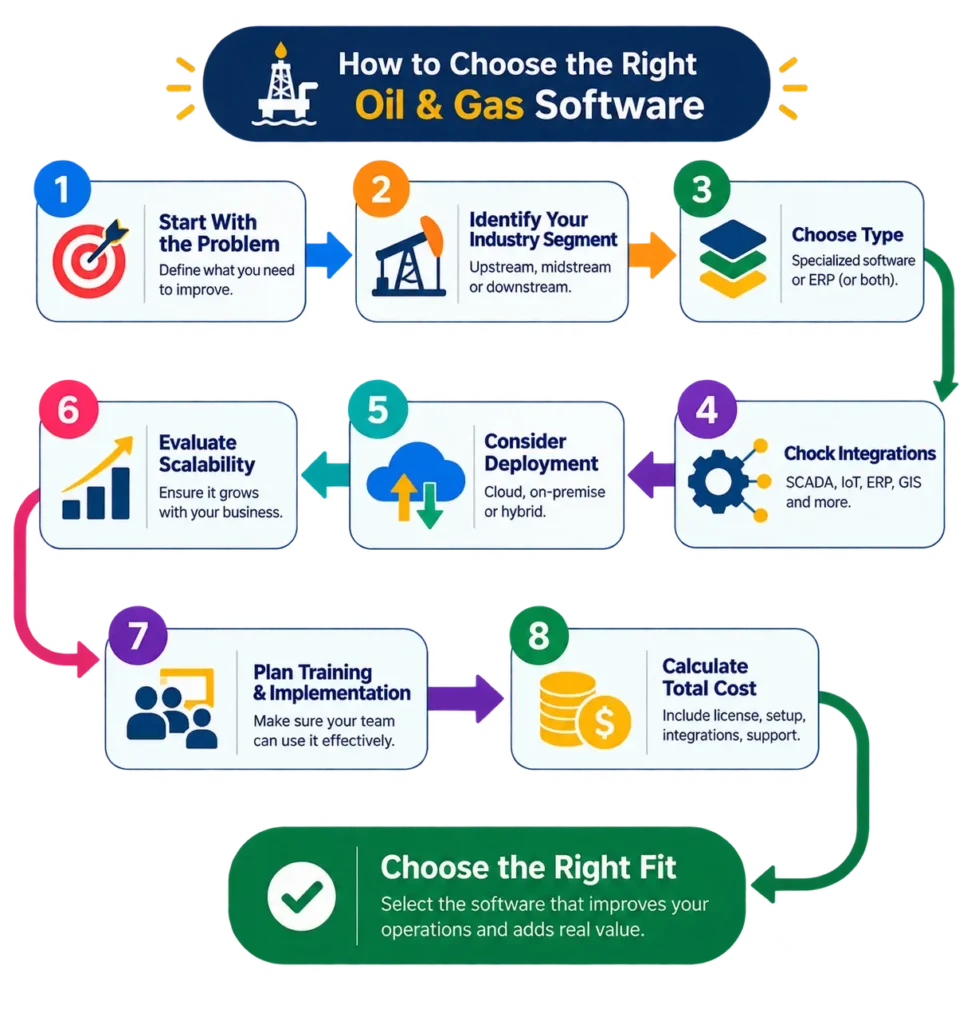
1. Start With the Problem, Not the Vendor
Are you trying to improve reservoir modeling, production, accounting, field tickets, maintenance or the entire enterprise?
Answering that question immediately eliminates many unsuitable products.
2. Identify Your Industry Segment
Upstream, midstream and downstream operations have different software requirements.
A reservoir engineering team doesn’t need the same platform as a pipeline operator.
3. Choose Between Specialized Software and ERP
Specialized software usually solves one technical problem extremely well.
ERP software connects broader business processes.
Many mature oil and gas companies use both, integrating specialized engineering or production systems with enterprise platforms.
4. Check Your Existing Technology Stack
Identify required connections to:
- SCADA
- IoT devices
- ERP
- Accounting systems
- GIS
- Data warehouses
- Field applications
- Engineering systems
Integration costs can matter as much as software licensing.
5. Consider Cloud vs On-Premise
Cloud software can simplify deployment and updates, while some organizations retain on-premise or hybrid environments because of infrastructure, operational or security requirements.
6. Evaluate Scalability
Software that works for 20 wells may not be appropriate for 20,000. Similarly, a small operator shouldn’t automatically buy the same enterprise platform used by a supermajor.
7. Evaluate Training and Implementation
A technically impressive platform creates little value if field crews, engineers or finance teams cannot use it effectively.
8. Calculate Total Cost of Ownership
Don’t compare only subscription or license fees. Include the total cost of implementation and software & API integration etc.
implementation + customization + integrations + migration + training + infrastructure + maintenance + support.
Key Features to Look for in Oil & Gas Software
The most important features depend on the problem you’re trying to solve, but several capabilities deserve particular attention.
Production & Operations Management
Upstream companies should consider well data, field capture, production allocation, operational reporting and integration with existing production systems.
Asset Management
For asset-intensive operations, look for preventive and predictive maintenance, work orders, equipment history, lifecycle management and asset-performance visibility.
Real-Time Data & Analytics
Modern operations generate data from wells, equipment, sensors and industrial systems. Your software should make that information usable rather than simply collect it.
Field & Mobile Access
Field workers shouldn’t have to return to the office simply to enter data. Mobile applications and offline functionality can be especially important at remote sites.
Accounting & ERP Integration
Check how easily production and operational information moves into finance, revenue accounting, procurement and other enterprise systems.
Regulatory & Compliance Management
Audit trails, reporting, permissions and structured records become increasingly important as operations grow.
AI & Predictive Analytics
AI can support anomaly detection, predictive maintenance and production optimization. However, don’t buy software simply because it advertises AI—the underlying use case and data quality matter more.
Integrations
Review APIs and compatibility with ERP, SCADA, IoT, GIS, accounting and other systems already used by your organization, if they’re compatible for software integration with the system you’re buying.
Security
Role-based access, identity management, data protection and security controls are essential when software connects operational and enterprise systems.
How Much Does Oil & Gas Software Cost?
Oil and gas software can cost anywhere from around $50–$500+ per user per month for smaller cloud-based tools to $50,000–$500,000+ per year for enterprise platforms, depending on the number of users, wells or assets, required modules, integrations, deployment model, implementation, data migration and support. Large ERP, reservoir modeling and asset-management systems are usually quote-based, and implementation costs can be as significant as the software license itself. For that reason, compare the total first-year cost and ongoing annual cost, not just the advertised subscription or license fee.
Is There Free Oil & Gas Software?
People searching for oil & gas software free or oil & gas software download should distinguish between free trials, open-source tools, educational applications and full commercial platforms. Some general field-management products offer free plans or trials, but specialized petroleum engineering, ERP, reservoir simulation and industrial software is commonly commercially licensed.
Free software may be useful for learning, experimentation or limited workflows. For production environments, evaluate security, support, data ownership, integration capability and long-term maintenance before making cost the deciding factor.
Also avoid downloading industrial software from unofficial third-party websites. For commercial platforms, use the vendor’s official download, trial or sales channel.
Off-the-Shelf vs Custom Oil & Gas Software
Not every organization needs to build software from scratch.
| Off-the-Shelf Software | Custom Oil & Gas Software |
|---|---|
| Faster implementation | Built around exact workflows |
| Proven functionality | Greater customization |
| Vendor maintains platform | More control over development |
| Existing integrations | Custom API integrations |
| Lower initial development effort | Higher initial investment |
| Vendor controls roadmap | Business controls roadmap |
Established platforms make sense when your workflows fit existing industry processes. Custom development becomes more attractive when you have proprietary workflows, unusual integrations, legacy systems, specialized field requirements or internal processes that commercial platforms cannot handle efficiently.
In some cases, the best architecture isn’t one or the other. It’s a hybrid: keep established ERP or engineering systems and build custom applications or integrations around them.
Conclusion
The best oil & gas software in 2026 depends on the problem you need to solve. Petrel is better suited to reservoir and subsurface workflows, Quorum to upstream operations, AVEVA to engineering and digital twins, IFS to asset management, SAP to large enterprise operations, and FieldCap to oilfield service workflows. Before choosing, compare industry fit, integrations, deployment, scalability, support and total cost so the software improves your operation rather than adding another disconnected system.
Frequently Asked Questions
What software do oil and gas companies use?
Oil and gas companies use different software depending on their size and operations. Common categories include ERP, production management, reservoir modeling, oil and gas accounting software, SCADA, asset management, field service, land management and analytics. Large operators often use multiple integrated systems rather than one application. Examples include SAP and IFS for enterprise processes, Petrel for subsurface workflows, Quorum for upstream operations, AVEVA for engineering and industrial data, and specialized applications for field operations.
What is the best software for oil and gas design?
There isn’t one universal design platform because oil and gas design includes different disciplines. AVEVA is a strong option for industrial engineering, design information and digital-twin environments, while Petrel is better suited to subsurface, geological and reservoir engineering workflows. The correct choice depends on whether you’re designing facilities and industrial assets or modeling underground reservoirs.
What is ERP in oil and gas?
ERP (Enterprise Resource Planning) in oil and gas is software that connects core business processes such as finance, procurement, assets, projects, accounting, supply chain and operational data within a shared system. Industry-specific ERP can also support areas such as production accounting, land, joint ventures and revenue processes. Examples relevant to the industry include SAP, IFS and Enertia.
What is SAP software in the oil and gas industry?
SAP provides enterprise software for oil, gas and energy companies covering areas including finance, planning, sourcing, operations and other business processes. SAP also provides industry-specific oil and gas capabilities. Its Production and Revenue Accounting functionality, for example, supports production volume allocation, revenue distribution, pricing, royalties and regulatory processes for upstream organizations.
