


- by Future Tech Core Editorial Team
- August 28, 2026
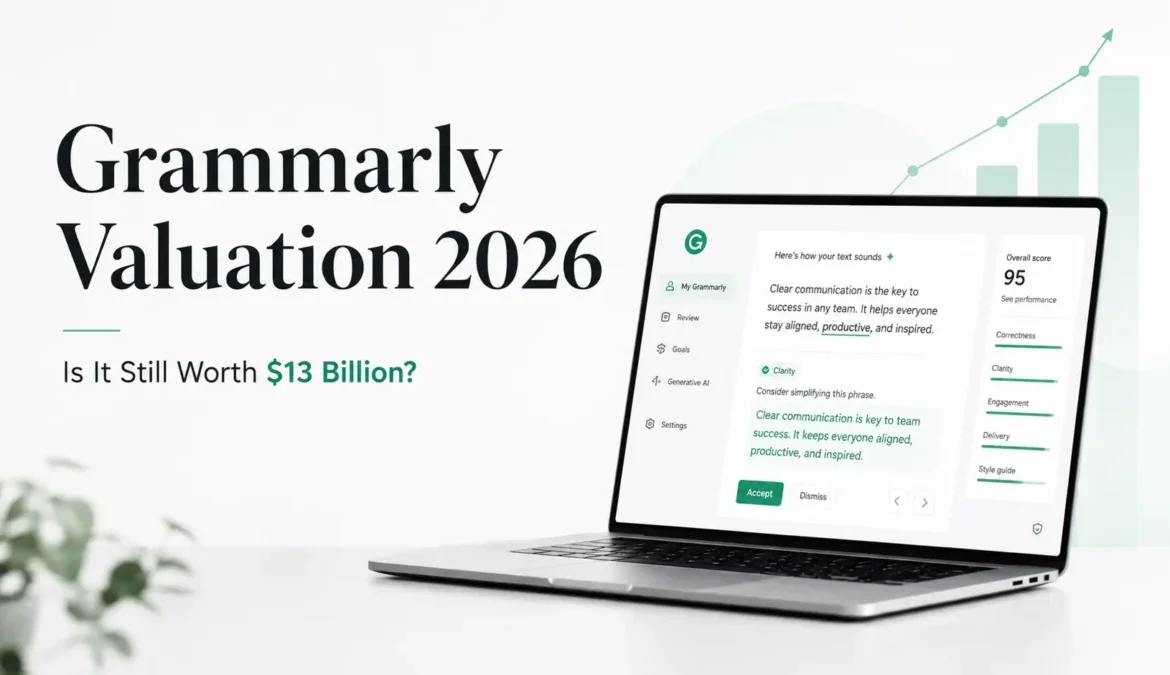
Grammarly’s last publicly announced priced equity valuation was $13 billion, set after a $200 million funding round in November 2021. However, that does not mean Grammarly is confirmed to be worth exactly $13 billion in 2026.
Since then, Grammarly has secured $1 billion in non-dilutive financing, expanded through acquisitions, and become part of the broader Superhuman company. It has also reported more than $700 million in annual revenue and 40 million daily users.
So, what is the Grammarly valuation in 2026? $13 billion remains its last major priced equity valuation, but no newer public equity round has confirmed that as its current market value.
Key Takeaways
- Grammarly was valued at $13 billion in November 2021 after raising $200 million.
- The $1 billion General Catalyst financing in 2025 was non-dilutive and did not establish a conventional new equity valuation.
- Grammarly’s corporate company adopted the Superhuman name in October 2025.
- Grammarly reported more than $700 million in annual revenue and over 40 million daily users in 2025.
- Private-market estimates can differ from the historical $13 billion figure.
- No publicly announced 2026 equity round has confirmed a new Grammarly valuation.
What Is Grammarly’s Valuation in 2026?
The last major publicly announced priced equity valuation for Grammarly is $13 billion, established in November 2021.
That figure continues to appear across Google, financial databases and company profiles because Grammarly has not publicly announced a later traditional equity round clearly replacing it with a new company-wide valuation.
However, Grammarly is privately held. Unlike a public company, it does not have a continuously updated market capitalization.
That means the $13 billion Grammarly value is best understood as a historical funding-round valuation rather than a confirmed 2026 market price.
Grammarly Valuation at a Glance
| Metric | Latest Verified Information |
|---|---|
| Last major priced equity valuation | $13 billion |
| Valuation date | November 2021 |
| 2021 funding round | $200 million |
| 2025 General Catalyst financing | $1 billion |
| New valuation established in 2025? | No conventional priced equity valuation announced |
| Reported annual revenue | More than $700 million |
| Reported daily users | More than 40 million |
| Current corporate company | Superhuman |
| Current CEO | Shishir Mehrotra |
| Publicly traded? | No |
Is Grammarly Still Worth $13 Billion in 2026?
$13 billion remains Grammarly’s best-known historical equity valuation, but there is not enough public evidence to say the company is worth exactly $13 billion today.
Three different values are often confused:
- Last priced valuation: the value established during an equity funding round.
- Private-market valuation: an estimate based on private share transactions or financing data.
- Current company value: what investors might pay for the whole company today.
Grammarly’s $13 billion figure mainly belongs to the first category.
Private-market platforms have since published estimates and transaction data that differ from the old benchmark. These can provide useful signals, but they are not equivalent to a new company-announced valuation.
So the more accurate statement is:
Grammarly’s last major priced equity valuation was $13 billion.
That is different from claiming Grammarly is definitely worth $13 billion in 2026.
Why Is Grammarly’s $13 Billion Valuation Still Quoted?
The figure comes from Grammarly’s November 2021 funding round, when the company raised $200 million at a $13 billion valuation.
New investors in that round included Baillie Gifford and funds managed by BlackRock.
At the time, Grammarly was already expanding beyond spelling and grammar corrections into broader AI-powered communication tools.
Because no subsequent traditional funding round has publicly established a replacement valuation, the $13 billion figure remains the number most frequently associated with Grammarly.
Grammarly Valuation History
| Year | Event | Amount | Reported Valuation |
|---|---|---|---|
| 2017 | Major funding round | About $110M | Not widely reported |
| 2019 | Funding round | $90M | More than $1B |
| 2021 | Major equity round | $200M | $13B |
| 2025 | General Catalyst growth financing | $1B | No new conventional priced valuation |
| 2026 | Current status | — | No publicly announced replacement for $13B |
Grammarly’s valuation increased rapidly between 2019 and 2021, rising from more than $1 billion to $13 billion.
This also explains searches for Grammarly valuation 2022. The company did not announce a major new priced equity round in 2022, so reports during that period generally continued referencing the $13 billion valuation established in late 2021.
Grammarly Valuation After ChatGPT: What Changed?
Grammarly’s $13 billion valuation came before ChatGPT was publicly released in November 2022.
That matters because generative AI dramatically changed the market for:
- writing assistance;
- rewriting;
- summarization;
- workplace productivity;
- AI-powered communication.
Grammarly suddenly faced competition not only from traditional writing tools but also from general-purpose AI assistants.
Instead of remaining focused primarily on grammar correction, Grammarly expanded deeper into generative AI, enterprise productivity and AI agents.
The Grammarly valuation after ChatGPT therefore depends increasingly on whether the company can turn its large existing user base into a broader AI productivity ecosystem.
What Happened With Grammarly’s $1 Billion Financing in 2025?
In May 2025, Grammarly secured $1 billion in financing from General Catalyst’s Customer Value Fund.
At first glance, a $1 billion deal may sound like another venture funding round that should have produced a new valuation.
It did not.
The financing was structured as non-dilutive growth capital, rather than a conventional equity investment where new shares are priced and sold.
Grammarly said the capital would support areas such as:
- customer growth;
- sales and marketing;
- strategic acquisitions;
- AI productivity expansion.
This distinction is important because the $1 billion financing did not automatically create a new Grammarly valuation.
Why the $1 Billion Financing Did Not Create a New Valuation
Traditional venture funding and non-dilutive financing work differently.
| Feature | Equity Funding | Non-Dilutive Financing |
|---|---|---|
| Investor normally receives equity | Yes | Not necessarily |
| Existing ownership can be diluted | Yes | Usually not in the same way |
| New share price may be established | Often | Not necessarily |
| Can establish new company valuation | Often | Not automatically |
| Grammarly 2021 round | Yes | No |
| Grammarly 2025 financing | No | Yes |
In a normal equity round, investors purchase ownership at an agreed share price, which can establish a new valuation.
The 2025 General Catalyst deal used a different structure. Therefore:
$1 billion in financing did not mean Grammarly had received a new $14 billion, $15 billion or other updated valuation.
Grammarly Became Superhuman: What Changed?
The Grammarly value question became more complicated in 2025 because Grammarly is no longer the name of the overall corporate platform.
After expanding through acquisitions, the company adopted the Superhuman corporate name in October 2025.
The broader platform now includes products such as:
- Grammarly — AI-powered writing assistance
- Coda — collaborative workspaces
- Superhuman Mail — email productivity
- Superhuman Go — AI assistance across apps and workflows
Grammarly itself still exists as a product.
This distinction matters when researching the Grammarly owner, valuation or potential IPO because investors are now effectively evaluating a broader AI productivity company rather than only the Grammarly writing assistant.
The strategy also reflects a wider movement toward connecting AI across different business applications. Our guide to software integration explains how separate applications can work together as part of a larger software ecosystem.
For readers interested in how apps exchange data and functionality, our explanation of API integration covers the underlying concept.
Does the Superhuman Rebrand Change Grammarly’s $13 Billion Valuation?
No. A company rebrand by itself does not create a new valuation.
What matters is the financial performance and strategic development around that rebrand, including:
- acquisitions;
- revenue growth;
- user adoption;
- enterprise expansion;
- AI products;
- profitability.
Superhuman could eventually receive a valuation above or below Grammarly’s historical $13 billion benchmark.
A new funding round, IPO, acquisition or other priced transaction would provide a much stronger current valuation signal.
What Could Grammarly and Superhuman Actually Be Worth in 2026?
There is no single publicly confirmed 2026 valuation for Grammarly/Superhuman.
Three measures help explain its potential value.
1. Last Priced Equity Valuation
The strongest historical benchmark remains:
$13 billion in 2021.
It came from an actual equity transaction but is now several years old.
2. Private-Market Indicators
Private-market platforms have published share-price and valuation estimates that differ from $13 billion.
These are useful indicators, but they should not be treated as official company valuations.
3. Business Fundamentals
Investors would also evaluate:
- revenue;
- profitability;
- enterprise customers;
- user growth;
- customer retention;
- AI adoption;
- acquisition performance.
Grammarly’s reported revenue of more than $700 million annually gives the company significant business scale.
Without a new priced transaction, however, assigning Grammarly a precise “true valuation” in 2026 would create false certainty.
Why Different Websites Show Different Grammarly Valuation Numbers
Someone searching Grammarly Crunchbase, Tracxn, private-market platforms or even Grammarly valuation Reddit discussions may encounter different numbers.
That does not necessarily mean the sources contradict each other.
They may be measuring different things:
- last equity-round valuation;
- post-money valuation;
- secondary share prices;
- estimated enterprise value;
- total funding;
- non-equity financing.
This is especially important with Grammarly because its 2025 $1 billion financing is not directly comparable with its 2021 equity round.
Reddit discussions can be useful for understanding public or investor sentiment, but they should not be treated as authoritative valuation evidence.
Startup databases such as Crunchbase and Tracxn can also be useful for researching funding history, but important valuation claims are stronger when confirmed through company announcements or established financial reporting.
How Much Revenue Does Grammarly Make?
The latest clearly disclosed figure is more than $700 million in annual revenue, reported in May 2025.
At that time, Grammarly also reported:
- more than 40 million daily users;
- more than 50,000 organizations using its platform.
Reuters additionally described the company as profitable.
These numbers help explain why Grammarly achieved a multibillion-dollar valuation.
However, a newer verified full-year 2026 revenue figure has not been publicly disclosed. For that reason, the $700 million-plus figure remains the clearest confirmed Grammarly revenue benchmark rather than relying on unsupported projections.
How Does Grammarly Make Money?
Grammarly primarily makes money through paid software subscriptions.
It operates a freemium model: users can access basic writing assistance for free, while individuals and organizations can pay for more advanced features.
Revenue comes from customers such as:
- individual subscribers;
- businesses;
- enterprise teams;
- educational organizations.
Recurring subscription revenue is important for Grammarly’s valuation because predictable software revenue can make future business performance easier for investors to evaluate.
Who Owns Grammarly?
There is no single publicly disclosed person who owns Grammarly outright.
The business is privately held, with ownership distributed among founders, employees and investors.
The Grammarly founders are:
- Max Lytvyn
- Alex Shevchenko
- Dmytro Lider
The company was founded in 2009.
Previous investors have included organizations such as:
- General Catalyst;
- Institutional Venture Partners;
- Baillie Gifford;
- BlackRock-managed funds.
Importantly, General Catalyst’s $1 billion 2025 financing should not be interpreted as the firm purchasing Grammarly outright.
Who Is the CEO of Grammarly in 2026?
Shishir Mehrotra is the CEO of Superhuman, the broader company that now includes Grammarly.
Mehrotra previously led Coda and became CEO as Grammarly expanded from a writing assistant into a wider AI productivity platform.
Older pages that list Rahul Roy-Chowdhury as Grammarly’s current CEO may therefore be outdated.
Is Grammarly Publicly Traded?
No.
Grammarly and its parent company Superhuman remain privately held and do not have an ordinary public stock ticker.
Private shares may sometimes appear through specialist secondary-market platforms, but those transactions are different from buying shares of a publicly traded company through an exchange such as Nasdaq or the NYSE.
Is a Grammarly or Superhuman IPO Coming?
There is no confirmed Grammarly or Superhuman IPO date in 2026.
The company has previously expressed interest in eventually going public, but no immediate timetable has been announced. Until Superhuman formally announces or files for an IPO, specific IPO-date predictions should be treated as speculation.
What Could Increase Grammarly’s Future Valuation?
Grammarly/Superhuman’s future valuation will depend more on business performance than its historical $13 billion benchmark. Several factors could support a higher value.
- Enterprise AI Adoption: Winning more large organizations could increase recurring enterprise revenue and strengthen customer retention.
- Revenue Growth: Continued growth beyond the reported $700 million-plus annual revenue level would provide stronger financial support for a higher valuation.
- Product Integration: Combining Grammarly, Coda, Superhuman Mail and Superhuman Go could increase revenue per customer if users adopt multiple products.
- AI Agents: Successful adoption of AI agents across workplace applications could create additional subscription and enterprise opportunities.
- Acquisitions: New products and acquired user bases could strengthen the wider platform when integrations are successful.
Ultimately, investors will likely focus on revenue growth, profitability, retention and AI adoption rather than the company’s historical funding headlines alone.
What Could Push Grammarly’s Valuation Lower?
The company also faces risks that could put downward pressure on its future valuation.
- AI Competition: ChatGPT and other AI assistants now offer writing, rewriting and summarization capabilities that overlap with Grammarly.
- Writing Tools Becoming Commoditized: Basic AI writing assistance is increasingly included inside larger productivity platforms.
- Integration Risk: Combining several products under Superhuman does not guarantee customers will adopt the entire ecosystem.
- Slower Growth: Slowing subscriptions, enterprise adoption or user growth could reduce investor expectations.
- Private-Market Conditions: Interest rates, liquidity and changing SaaS valuation multiples can affect private-company values.
Maintaining a premium valuation will therefore depend on whether Superhuman can translate its larger platform strategy into sustainable revenue and competitive advantages.
So, Is Grammarly Really Worth $13 Billion in 2026?
$13 billion remains Grammarly’s most widely recognized major equity valuation, but it should not be treated as a confirmed 2026 market price.
That number was established in November 2021.
Since then:
- ChatGPT transformed the AI writing market;
- Grammarly reported more than $700 million in annual revenue;
- General Catalyst provided $1 billion in non-dilutive financing;
- Grammarly expanded through acquisitions;
- the corporate company became Superhuman;
- private-market indicators began diverging from the historical benchmark.
Therefore, the most accurate answer to “What is Grammarly’s valuation in 2026?” is:
Grammarly’s last major publicly announced priced equity valuation was $13 billion in 2021. No newer conventional equity round has definitively replaced that figure, so $13 billion remains a historical valuation rather than a confirmed 2026 market value.
Frequently Asked Questions
Is Grammarly still worth it in 2026?
Yes, Grammarly can still be worth using if you regularly write emails, reports or professional content and need editing, rewriting and tone assistance. Whether the paid version is worthwhile depends on how often you use its advanced AI features.
Who is the CEO of Grammarly?
Shishir Mehrotra is CEO of Superhuman, the company that now includes Grammarly. He previously served as CEO of Coda.
How does Grammarly earn money?
Grammarly primarily earns money through paid subscriptions for individuals, businesses, enterprise teams and educational organizations while also offering free writing tools.
How much is Grammarly making?
Grammarly reported more than $700 million in annual revenue in May 2025. A newer verified full-year 2026 revenue figure has not been publicly disclosed.
Sources and Methodology
This article prioritizes official company announcements and established financial reporting instead of relying on a single startup database or unsupported valuation estimate.
Key sources used for the analysis include:
- Grammarly and Superhuman company announcements covering financing, products and the corporate rebrand;
- Reuters reporting on financing, revenue, profitability and future IPO ambitions;
- TechCrunch reporting on Grammarly’s 2021 $13 billion valuation and later company developments;
- private-market sources such as Forge and Nasdaq Private Market, used only as indicators rather than definitive official valuations.
Because Grammarly/Superhuman remains privately held, current valuation estimates can vary. Third-party estimates should therefore be distinguished from valuations established through actual priced equity transactions.