

- by Ammara Bano
- August 15, 2026
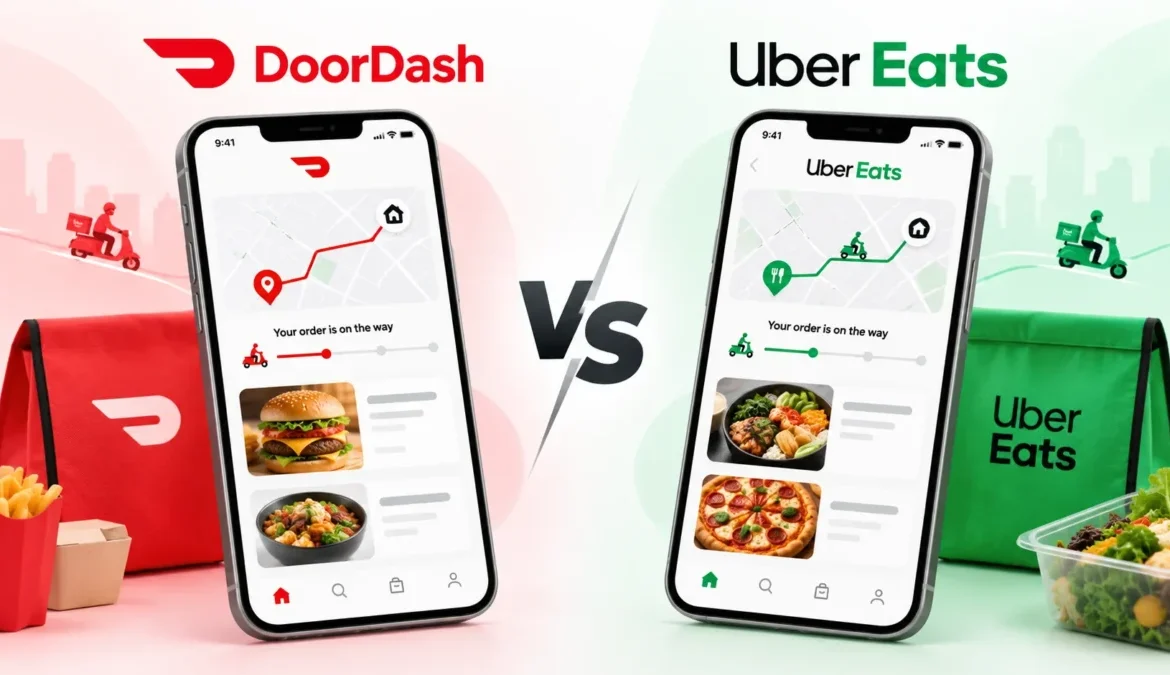
If you are comparing DoorDash vs UberEats, there is no single winner for everyone. DoorDash is generally the stronger choice for broad U.S. restaurant coverage and suburban availability, while Uber Eats can be more competitive for urban users, promotions, and people who already use the wider Uber ecosystem. For drivers, the better app depends heavily on local demand, order volume, tips, distance, and time of day rather than one platform always paying more.
The best choice comes down to how you use food delivery: as a customer, driver, or restaurant.
DoorDash vs UberEats at a Glance
| Category | DoorDash | Uber Eats | Better Choice |
|---|---|---|---|
| U.S. restaurant coverage | Very strong | Strong | DoorDash |
| Urban availability | Strong | Very strong | Uber Eats |
| Promotions and deals | Good | Often strong | Uber Eats |
| Subscription | DashPass | Uber One | Depends on usage |
| Delivery fees | Varies | Varies | Depends on order |
| Driver flexibility | Strong | Strong | Tie |
| Driver earnings | Market-dependent | Market-dependent | Depends on city |
| Merchant reach | Very strong in U.S. | Strong | DoorDash |
| Cross-platform ecosystem | DoorDash-focused | Uber + Uber Eats | Uber Eats |
The key point is that the cheapest or fastest platform can change from one order to the next.
Which Is Better Overall: DoorDash or Uber Eats?
For most U.S. customers, DoorDash has an edge in restaurant selection and geographic reach. Uber Eats is especially competitive in dense urban areas and can be attractive when promotions or Uber One benefits reduce the final order total.
For drivers, there is no universal winner. DoorDash and Uber Eats both use variable earnings models, and actual income depends on location, order demand, distance, tips, promotions, and how selectively a driver accepts offers. DoorDash offers both Earn per Offer and Earn by Time modes, while Uber Eats shows upfront delivery fares based on estimated time, effort, and real-time local conditions.
For restaurants, DoorDash currently offers clearer tiered U.S. merchant pricing, while Uber Eats also uses tiered marketplace fees that vary by package and market.
DoorDash vs Uber Eats for Customers
Which Is Cheaper: DoorDash or Uber Eats?
Neither app is consistently cheaper. The final checkout price can be affected by:
- restaurant menu pricing
- delivery fee
- service fee
- long-distance charges
- local regulatory fees
- order size
- active promotions
- subscription membership
- taxes
DoorDash says its customer service fee is variable and can depend on factors such as distance and order size, while delivery fees vary by merchant. Additional long-distance or regulatory fees may also apply in some markets.
Uber Eats also varies charges by restaurant, order, location, and eligibility for Uber One benefits. Because both platforms can show different promotions or merchant pricing at the same time, the most accurate way to compare DoorDash vs Uber Eats prices is to build the same order in both apps and compare the final checkout total before paying.
That is more useful than assuming one service is always cheaper.
DoorDash vs Uber Eats Delivery Fees
Delivery fees are not fixed across either platform.
DoorDash states that its delivery fee varies by merchant, while service fees can vary according to order characteristics such as distance and size.
Uber Eats similarly applies different fees depending on the store, location, and order conditions. Membership benefits can reduce some charges on eligible orders, but they do not eliminate every possible fee.
This means a restaurant that is cheaper on DoorDash today may be cheaper on Uber Eats tomorrow if a promotion changes.
Which Has More Restaurants?
DoorDash is generally the stronger option for broad U.S. restaurant coverage, particularly across suburban and smaller markets.
Uber Eats remains highly competitive in major cities and has the added advantage of being part of Uber’s wider mobility platform.
For customers, however, national scale matters less than local availability. If your favorite restaurants are only listed on one platform, that platform is automatically the better choice for you.
Which Is Faster: DoorDash or Uber Eats?
There is no reliable nationwide answer.
Food delivery speed depends on:
- restaurant preparation time
- distance to the customer
- number of available couriers
- traffic
- local demand
- weather
- whether the driver is completing multiple deliveries
- the accuracy of the restaurant’s preparation estimate
A common mistake in Uber Eats vs DoorDash comparisons is treating delivery speed as a permanent platform advantage.
In reality, one restaurant may deliver faster through DoorDash while another performs better through Uber Eats in the same city.
DoorDash vs Uber Eats App Experience
Both services provide the core features customers expect from modern food delivery apps:
- restaurant search
- categories and filters
- order tracking
- saved addresses
- reorder options
- promotions
- ratings and reviews
- in-app support
- delivery instructions
The differences are more about ecosystem and preference than basic functionality.
Uber Eats benefits from integration with the broader Uber account and membership ecosystem. DoorDash, meanwhile, has expanded beyond restaurant delivery into groceries, convenience products, and other local delivery categories.
This is a good example of how the use of mobile applications in business has evolved beyond simple ordering. Modern apps now combine payments, logistics, customer service, promotions, tracking, and account management in a single mobile workflow.
DashPass vs Uber One
For frequent customers, membership can change the comparison significantly.
DoorDash says DashPass costs $9.99 per month or $96 annually in the U.S. and offers $0 delivery fees and reduced service fees on eligible orders.
Uber One currently costs $9.99 per month in the U.S. and includes $0 delivery fees on eligible orders, discounts on eligible delivery and pickup orders, and benefits across both Uber and Uber Eats.
The better membership depends on your habits.
Choose DashPass if most of your spending is on DoorDash restaurants and local delivery.
Choose Uber One if you regularly use both Uber rides and Uber Eats.
One important 2026 change is that Uber updated some Uber One service-fee benefits, so users should check the current membership terms in their region rather than relying on older comparisons.
DoorDash vs Uber Eats for Drivers
Which Pays More: DoorDash or Uber Eats?
There is no dependable national winner for DoorDash vs Uber Eats driver pay.
DoorDash says Dasher earnings consist of:
- base pay
- promotions
- customer tips
Dashers can choose between Earn per Offer and Earn by Time where available. DoorDash states that Earn per Offer pay varies based on estimated time, distance, and desirability, while Earn by Time uses a guaranteed active hourly rate during accepted deliveries. Drivers keep 100% of tips.
Uber Eats uses upfront fares that account for expected time and effort, along with real-time conditions. Uber says drivers also keep 100% of customer tips and may earn additional money through promotions such as Quest and Boost+.
That makes local market conditions far more important than national averages.
A driver in one city may earn more consistently on DoorDash, while another may get better-paying Uber Eats offers.
Which Has Better Order Volume?
DoorDash often performs strongly in suburban U.S. markets because of its broad restaurant network.
Uber Eats can be especially competitive in dense urban areas.
But driver order volume can change throughout the day.
Lunch, dinner, weekends, weather, major events, and local promotions all influence demand.
That is why many gig drivers compare apps in real time instead of committing to one platform permanently.
Driver Flexibility
Both platforms are designed around flexible gig work.
DoorDash lets drivers choose among available earning modes and shows earning opportunities in the Dasher app.
Uber Eats shows estimated pay, pickup and drop-off information, time, and distance before a delivery is accepted.
For drivers, the most useful comparison is not simply which app has higher advertised earnings. It is:
Which app gives you better orders in your area during the hours you actually work?
That is the metric that matters.
Driver Promotions
Both platforms use promotions to increase supply in high-demand periods.
DoorDash promotions can include Peak Pay, Challenges, Boosts, and other incentives that vary by location and time.
Uber Eats may offer Quest and Boost+ promotions depending on the driver’s market and eligibility.
Promotions can improve short-term earnings, but they should not be treated as guaranteed income.
DoorDash vs Uber Eats for Restaurants
Restaurants care about a different set of factors than customers or drivers.
The key comparison is usually:
- commission rates
- delivery reach
- pickup fees
- marketing tools
- customer exposure
- POS integration
- operational control
DoorDash currently lists three U.S. merchant delivery plans for eligible restaurants:
- Basic: 15%
- Plus: 25%
- Premier: 30%
Pickup commission is listed at 6% across the plans, subject to DoorDash’s eligibility and pricing terms.
Uber Eats updated its U.S. marketplace pricing in March 2026. Its published standard delivery rates include:
- Lite: 20%
- Plus: 25%, with 30% on some Uber One member orders
- Premium: 30%
Pickup is listed at 7% with validated in-store pricing, otherwise 10%, though Uber notes that rates can vary by market.
For restaurants, a lower commission is not automatically the best deal. A platform that brings substantially more orders can still be more valuable despite a higher rate.
Restaurants should model:
commission cost + order volume + average ticket + promotion spend + operational workload
before choosing.
POS Integrations Matter for Restaurants
For busy restaurants, delivery platforms should fit into the wider ordering system rather than operate as isolated tablets.
Restaurants increasingly connect delivery marketplaces with POS software so orders can flow into kitchen, inventory, reporting, and payment systems more efficiently.
If you are evaluating restaurant technology more broadly, our comparison of the best POS systems explains how platforms such as Toast, Square, and other restaurant-focused systems handle ordering, payments, inventory, and integrations.
Behind many of these connections is API integration, which allows delivery, POS, payment, and other software systems to exchange data automatically.
DoorDash vs UberEats by Use Case
| Use Case | Better Choice |
|---|---|
| Broad U.S. restaurant coverage | DoorDash |
| Suburban delivery | DoorDash |
| Dense urban markets | Uber Eats |
| Promotions | Often Uber Eats |
| Frequent DoorDash customer | DashPass |
| Frequent Uber + Uber Eats user | Uber One |
| Driver earnings | Depends on market |
| Driver order volume | Depends on location |
| Restaurant reach in U.S. | DoorDash often stronger |
| Lowest merchant entry commission | DoorDash Basic |
| Cross-service membership | Uber One |
This is not a permanent ranking. Availability and pricing can change by city, restaurant, and time.
DoorDash Pros and Cons
Pros
- Broad restaurant coverage in the U.S.
- Strong suburban presence
- DashPass membership
- Large delivery network
- Grocery and convenience delivery
- Strong merchant reach
Cons
- Final fees vary by order
- Promotions may differ by restaurant
- Driver experience varies by market
- Not always the cheapest option
UberEats Pros and Cons
Pros
- Strong urban presence
- Frequent promotions in many markets
- Integration with the wider Uber ecosystem
- Uber One benefits across rides and delivery
- Broad international presence
Cons
- Prices and fees can vary significantly
- Restaurant selection may be smaller in some areas
- Driver earnings vary by local demand
- Membership benefits change by market and eligibility
How We Compared DoorDash and UberEats
This comparison focuses on the factors most relevant to customers, drivers, and restaurants:
- customer fees
- restaurant selection
- delivery speed
- subscription benefits
- promotions
- app experience
- driver earnings structure
- driver flexibility
- merchant commission
- restaurant reach
- software integrations
Current fee and program information was checked against DoorDash and Uber’s published documentation where available.
Because both companies change pricing, promotions, and program benefits frequently, users should confirm the final terms shown in their app or merchant account before making a decision.
Which Should You Choose?
Choose DoorDash if you:
- want broad U.S. restaurant selection
- live in a suburban market
- regularly order from DashPass restaurants
- want strong local delivery coverage
Choose UberEats if you:
- live in a dense urban area
- regularly find better promotions there
- already use Uber rides
- can benefit from Uber One across multiple Uber services
For drivers, the best strategy is different.
Do not choose based on national averages alone. Compare actual offers, pay per mile, delivery time, tips, and order frequency in your local market.
Final Verdict
In the DoorDash vs UberEats comparison, DoorDash is usually the stronger all-around choice for U.S. restaurant coverage and suburban availability, while Uber Eats can be more attractive for urban users, promotions, and customers who already use Uber.
Neither platform is always cheaper or faster.
For drivers, local demand matters far more than brand reputation. For restaurants, commission rates should be weighed against order volume, customer reach, and operational integrations.
The best approach is simple: compare the apps based on the way you actually use food delivery rather than looking for one universal winner.
Frequently Asked Questions
Which one is better, DoorDash or Uber Eats?
DoorDash is generally stronger for broad U.S. restaurant coverage and suburban availability, while Uber Eats can be better for urban users, promotions, and customers who already use Uber. For drivers, the better app depends heavily on local demand, tips, distance, and order volume.
Can I make $1,000 a week with Uber Eats?
It is possible in some markets, but it is not guaranteed. Reaching $1,000 in a week depends on factors such as hours worked, local demand, tips, delivery distance, promotions, and expenses like fuel and vehicle maintenance.
Can I make $1,000 in a week with DoorDash?
Some Dashers may reach $1,000 in a strong market with enough hours and favorable order volume, but earnings vary widely. Drivers should focus on actual local demand, pay per mile, tips, and operating costs rather than assuming a fixed weekly income.
How many hours is $100 on DoorDash?
There is no fixed number of hours because DoorDash earnings vary by market, time of day, tips, promotions, distance, and order quality. A driver may reach $100 faster during busy periods and much more slowly during low-demand hours.
Is DoorDash cheaper than Uber Eats?
Not always. Final prices depend on restaurant pricing, delivery fees, service fees, promotions, subscriptions, taxes, and location.
Which pays drivers more, DoorDash or Uber Eats?
Neither platform consistently pays more everywhere. Driver earnings depend on city, demand, distance, tips, promotions, and the types of orders accepted.
Which is faster, DoorDash or Uber Eats?
Delivery speed depends primarily on restaurant preparation, distance, traffic, courier availability, and local demand rather than the platform alone.