

- by Ammara Bano
- August 15, 2026
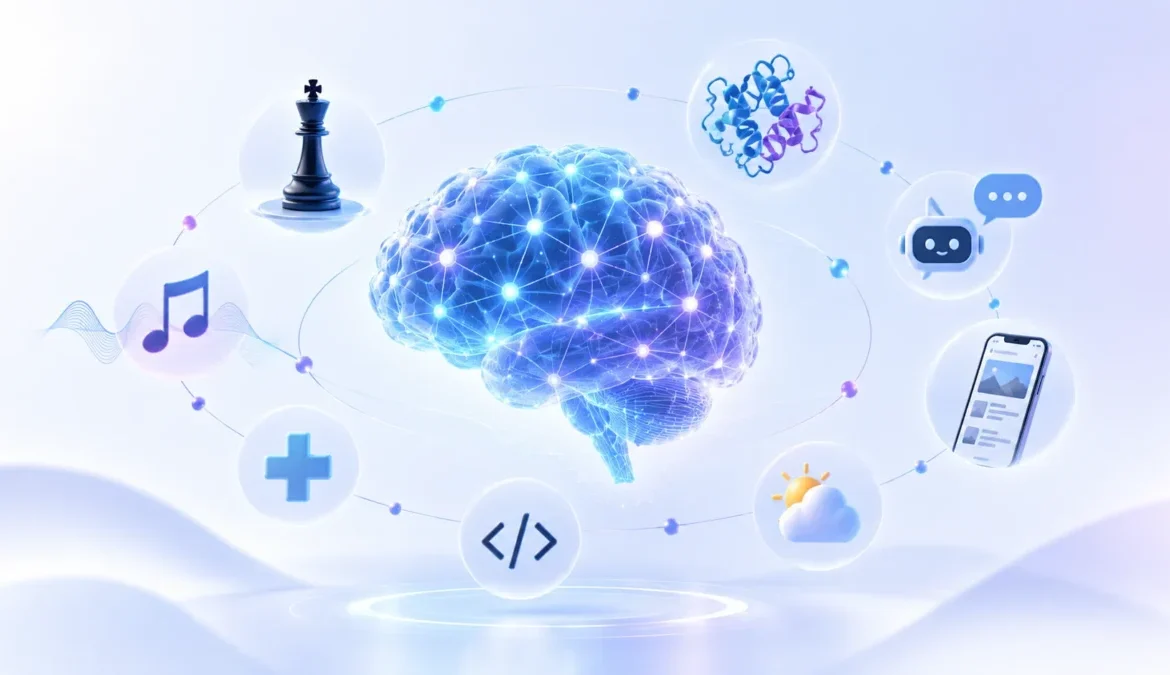
Artificial intelligence is much older, and much stranger, than ChatGPT. The term artificial intelligence dates to 1956, AI has defeated world champions at chess and Go, helped predict more than 200 million protein structures, generated images and music from simple prompts, assisted with weather forecasting, and even helped researchers turn brain activity into speech.
These interesting facts about AI show how the technology has moved from experimental computer programs into science, medicine, software, finance, and everyday digital life.
If you’re looking for a quick fun fact about AI, start here: some of today’s most advanced systems trace their field back about 70 years.
Quick AI Facts at a Glance
| AI Fact | Why It Is Interesting |
|---|---|
| AI got its name in 1956 | The field predates the modern internet by decades |
| ELIZA appeared in the 1960s | People became emotionally engaged with a very simple chatbot |
| Deep Blue beat Garry Kasparov | A computer defeated a reigning chess world champion |
| AlphaGo defeated Lee Sedol | AI mastered a game once considered exceptionally difficult for computers |
| AlphaFold predicted 200M+ protein structures | AI is helping accelerate biological research |
| AI can create images and music from prompts | Generative AI now works across several types of media |
| AI systems can hallucinate | A confident answer is not always a correct answer |
| AI-generated data can damage future AI training | Researchers call this effect model collapse |
AI History and Early Milestones
1. Artificial Intelligence Got Its Name in 1956
Artificial intelligence may feel like a new technology, but the field’s modern identity dates back to the Dartmouth Summer Research Project on Artificial Intelligence in 1956.
John McCarthy helped organize the workshop with Marvin Minsky, Nathaniel Rochester, and Claude Shannon. Dartmouth describes the meeting as the point where the term “artificial intelligence” was coined and the new research field began taking shape.
2. One of the First Chatbots Was Built 60 Years Ago
Long before ChatGPT, there was ELIZA.
Computer scientist Joseph Weizenbaum developed the chatbot in the 1960s to imitate a simple psychotherapy-style conversation. ELIZA did not understand users in the modern sense; it mainly used pattern matching and scripted responses.
The surprising part was how people reacted. Some users spoke to ELIZA as though it genuinely understood them, illustrating how easily humans can assign personality or intelligence to software that produces convincing conversation.
3. AI Defeated a Chess World Champion in 1997
IBM’s Deep Blue defeated reigning world chess champion Garry Kasparov in a six-game match in May 1997.
Deep Blue relied heavily on enormous computing power and could evaluate up to 200 million chess positions per second. Its victory became one of the best-known milestones in computing because chess had long been treated as a difficult test of machine intelligence.
AI has changed dramatically since then, but Deep Blue remains an important part of AI history.
4. AlphaGo Mastered a Game Far More Complex Than Chess
In March 2016, Google DeepMind’s AlphaGo defeated Lee Sedol 4–1 in Go.
Go is especially difficult for computers because the number of possible board positions is enormous. AlphaGo combined neural networks with reinforcement learning rather than relying only on brute-force calculations.
One of its moves during the match was so unusual that DeepMind estimated it had roughly a 1-in-10,000 chance of being played by a human, yet it helped AlphaGo win.
This was an important sign that AI systems could discover strategies humans had not commonly used.
Surprising Things AI Can Do
5. AI Can Create Images From Ordinary Language
You no longer need to draw or write code to create a new digital image.
Modern generative AI systems can turn plain-language instructions into original visuals. A user can describe the subject, lighting, composition, background, or style and then refine the result through follow-up instructions.
OpenAI’s current image-generation guidance, for example, describes creating and revising images directly from natural-language prompts.
That shift has made image creation accessible to people without traditional design or illustration skills.
6. AI Can Turn Text, and Even Images, Into Music
AI generation is not limited to text and pictures.
Google DeepMind’s current Lyria family can generate music from prompts, including vocals, lyrics, musical styles, and specified track lengths. Its latest versions can also use an image as creative input for generating music.
That makes modern AI capable of working across several creative formats at once.
The important distinction is that these tools assist with musical creation; they do not make questions around copyright, artistic ownership, and responsible use disappear.
7. AI Can Write, Explain, and Debug Computer Code
AI coding assistants can suggest code while a developer types, explain unfamiliar code, help with command-line tasks, and increasingly work across larger development workflows.
GitHub describes Copilot as an AI coding assistant that can generate suggestions, answer questions about code, help plan changes, and assist with pull requests.
That does not make software engineering automatic. Developers still need to review security, logic, architecture, and whether generated code actually solves the intended problem.
But AI has clearly moved from discussing code to actively participating in software development.
8. AI Can Create Convincing Fake Images, Voices, and Videos
Generative AI can also produce synthetic media that appears authentic.
NIST describes deepfakes as AI-generated or manipulated image, audio, or video content that can falsely appear to show genuine people, objects, places, or events.
The technology can have legitimate creative uses, but realistic synthetic media also raises concerns about impersonation, misinformation, fraud, and digital evidence.
This is one reason AI-generated media increasingly matters to cybersecurity and online trust—not only entertainment.
Interesting AI Facts About Science and Medicine
9. AI Has Predicted More Than 200 Million Protein Structures
One of AI’s most impressive achievements has little to do with chatbots.
Google DeepMind’s AlphaFold database contains more than 200 million predicted protein structures, covering nearly all catalogued proteins known to science. DeepMind says millions of researchers across more than 190 countries have used AlphaFold.
Why does that matter?
The shape of a protein helps determine how it works. Better structural information can support research into disease, drug discovery, antimicrobial resistance, crops, and many other areas of biology.
10. An AI Weather Model Can Produce a 10-Day Forecast in Under a Minute
Weather forecasting normally requires enormous amounts of scientific computation.
Google DeepMind’s GraphCast demonstrated that a machine-learning system could produce a 10-day global weather forecast in under 60 seconds on specialized hardware.
In the research evaluation, GraphCast outperformed the ECMWF’s deterministic HRES system on most of the variables and forecast times tested.
That does not mean conventional weather science has become unnecessary. Instead, AI is becoming another powerful tool for producing fast forecasts alongside physics-based approaches.
11. AI Is Already Used in Regulated Medical Devices
AI in medicine is no longer only a research experiment.
The U.S. Food and Drug Administration maintains a public list of AI-enabled medical devices authorized for marketing, with many entries falling under radiology alongside areas such as neurology and cardiovascular care.
AI-enabled medical tools can assist with tasks such as analyzing scans, identifying patterns, segmenting medical images, or supporting clinical workflows.
An important point is that these systems are medical tools—not independent doctors. Their safety and usefulness depend on the specific device, intended use, clinical evidence, and human oversight.
12. Researchers Can Translate Brain Activity Into Speech
One of the most remarkable recent AI applications involves helping people who have lost the ability to speak.
In 2025, researchers reported brain-computer interfaces that used machine learning to decode neural activity and synthesize speech. One Nature study demonstrated real-time voice generation for a person with ALS, including changes in intonation.
NIH has also highlighted research into decoding inner speech from brain activity.
These remain specialized research systems, but they show how AI can help translate biological signals into communication.
Interesting AI Facts About Everyday Life
13. You Probably Use AI Without Thinking About It
AI does not always look like a chatbot.
It can appear quietly inside:
navigation systems, spam filters, search tools, smartphone cameras, fraud monitoring, translation, product recommendations, and social-media feeds.
For example, YouTube’s recommendation system uses signals such as viewing history, searches, subscriptions, likes, dislikes, and satisfaction feedback to personalize what people see.
That makes recommendation systems one of the most familiar examples of artificial intelligence in everyday life—even when users never describe them as “AI.”
14. Recommendation AI Can Process Enormous Amounts of Behavior Data
A recommendation system is doing much more than remembering the last video you watched.
YouTube says its current recommendation system learns from more than 80 billion pieces of information it calls signals, using factors such as viewing history, searches, likes, dislikes, subscriptions, and user feedback.
This is a useful reminder that some of the world’s most influential AI systems are not generative models.
They are prediction systems quietly deciding what video, song, product, or post you may want to see next.
15. AI Helps Financial Systems Detect Suspicious Transactions
Financial institutions use AI and machine learning to analyze patterns that would be difficult to review manually at huge scale.
A system can compare transactions with normal behavior, identify unusual activity, score risks, or help prioritize cases for investigation.
Fraud detection is only one example. AI is also used in lending, customer service, compliance, personalization, and investment-related workflows. Our broader guide to explains how these applications fit together.
The important point is that AI often works behind the scenes rather than directly interacting with customers.
16. AI Is Increasingly Connected to Other Software, Not Used Alone
Modern AI tools rarely operate in complete isolation.
Businesses increasingly connect AI services with CRMs, databases, customer-support platforms, analytics tools, websites, and internal applications. That allows an AI system to receive information or trigger actions within a larger workflow.
This is where AI intersects naturally with through API integration. An AI model may generate the answer, but APIs and integrations often determine how information reaches the model and what happens with its output afterward.
Weird and Fun AI Facts
17. AI Can “Hallucinate” Things That Never Happened
The word sounds human, but AI hallucination has a specific technical meaning.
NIST uses the term confabulation for cases where generative AI confidently produces erroneous or false information. These systems generate outputs from learned statistical patterns, so a response can sound convincing even when it is wrong.
That is why an eloquent AI answer should never automatically be treated as evidence.
For research, medical, financial, or legal questions, important facts still need to be checked against reliable sources.
18. AI Can Learn Bias From Human Data
AI does not learn in a social vacuum.
Training data, design decisions, measurement choices, and the environments where systems are deployed can introduce or reinforce bias.
NIST notes that harmful biases can occur across technology processes and affect systems used to categorize, recommend, or make decisions about people.
This is why responsible AI is not simply about building a more accurate model. Developers also need to ask whether errors or decisions affect different groups unfairly and whether the data represents the people the system will encounter.
19. AI Language Models Do Not Work Like Human Minds
A chatbot can produce remarkably human-sounding language without generating sentences the way a person does.
Modern language models learn statistical patterns from large amounts of data and generate likely sequences of tokens. NIST notes that this statistical generation process can produce both accurate output and confident errors.
So conversational ability should not automatically be confused with human consciousness, judgment, or understanding.
That distinction is easy to forget because natural language makes AI systems feel much more human than older software interfaces ever did.
20. Too Much AI-Generated Training Data Can Make AI Worse
This may be the strangest AI fun fact on the list: AI-generated content can potentially damage future AI systems when used carelessly as training data.
A 2024 Nature study found that repeatedly training generative models on data produced by earlier models can lead to model collapse. Over generations, the systems begin losing information about the original data distribution.
This does not mean AI-generated data can never be used safely. The study concerns indiscriminate recursive training.
But it highlights something important: high-quality human-generated and carefully curated data may become even more valuable as synthetic content spreads online.
What Is the Most Surprising Fact About AI?
If we had to choose one, AlphaFold’s scale is hard to beat.
AI is often discussed in terms of chatbots, pictures, or automation, but AlphaFold has predicted structures for more than 200 million proteins and made them available to researchers around the world.
That shows why the impact of artificial intelligence is much broader than consumer AI tools.
Some of its most important applications may happen inside scientific research rather than on a phone or laptop screen.
How Has AI Changed Since ChatGPT?
ChatGPT helped make generative AI mainstream, but the field has since expanded far beyond text chat.
By 2026, modern AI systems can work across text, images, audio, code, and other data types. Image models can follow natural-language editing instructions, music models can generate complete tracks, coding assistants can work across development tasks, and AI is increasingly being connected to external software and workflows.
The bigger change is therefore not simply that AI has become “smarter.”
It has become more multimodal, more connected, and more embedded in real products and workflows.
What These AI Facts Tell Us
The most interesting thing about artificial intelligence is how broad the field has become.
AI can play games, generate creative media, analyze medical information, forecast weather, help researchers study proteins, recommend videos, assist developers, and support people who have lost the ability to speak.
At the same time, AI can produce false information, reproduce bias, and fail when its training data becomes unreliable.
That is why the best way to understand AI in 2026 is neither to treat it as magic nor dismiss it as hype. Its capabilities are real, but so are its limitations. The surprising part is how quickly both are evolving.
Frequently Asked Questions
What are 100 interesting facts about AI?
There are well over 100 interesting facts about AI across its history, science, everyday use, and modern capabilities. For example, AI was formally named in 1956, Deep Blue beat a chess world champion, AlphaGo mastered Go, AlphaFold predicted more than 200 million protein structures, and modern AI can generate text, images, music, code, and speech. This guide focuses on 20 of the most useful and surprising AI facts rather than padding the article with a very long list.
What are 5 good things about AI?
Five major benefits of AI are:Faster data analysis — AI can process large datasets quickly.Healthcare support — AI can help analyze medical images and research data.Automation — repetitive tasks can be handled automatically.Accessibility — speech, translation, and assistive technologies can help more people use digital services.Scientific discovery — systems such as AlphaFold show how AI can accelerate research.
What are 5 uses of AI in daily life?
Five common everyday uses of AI are:Recommendation systems on YouTube, Netflix, and shopping platformsNavigation and traffic prediction in mapping appsSpam and fraud detection in email and bankingVoice assistants and chatbotsSmartphone photography, including image enhancement and object recognitionMany people therefore use AI several times a day without consciously thinking about it.
What are some interesting facts about AI for kids?
A few easy AI facts for kids are that AI got its name in 1956, a computer beat a world chess champion in 1997, AI can create pictures from written descriptions, some robots use AI to navigate, and AI can help scientists study proteins and weather. AI is powerful, but it can also make mistakes, so people still need to check its work.
What are 5 fun random facts?
In the context of AI, five fun random facts are: One of the first chatbots, ELIZA, was created in the 1960s. Deep Blue could examine up to 200 million chess positions per second. AlphaGo played a move experts considered extremely unusual. AI systems can “hallucinate” information that sounds believable but is false. Too much recursively generated AI training data can contribute to model collapse.
What is a shocking fact about AI?
One surprising AI fact is that AlphaFold has predicted structures for more than 200 million proteins. That matters because understanding protein structures can support research into disease, drugs, biology, and other scientific problems that once required much slower experimental work.
What are 10 funny facts?
If you mean funny or unusual AI facts, here are ten: AI can hallucinate without having a brain. ELIZA convinced some users it understood them despite using simple rules. AI can write poems but has no personal feelings about them. It can create a realistic face of someone who never existed. AI can generate music without ever hearing it as a human does. Recommendation algorithms can know your viewing habits better than you remember them. AlphaGo surprised professional Go players with unusual moves. AI can confidently give a completely wrong answer. AI-generated content can eventually make future AI models worse if reused carelessly. A chatbot can sound human while processing language very differently from a human mind.