Search engines have evolved far beyond simple keyword matching. Today, they understand meaning, context, and relationships between concepts F, a shift that’s transformed SEO forever. This approach is called Semantic SEO, and it’s at the heart of modern digital marketing strategies.
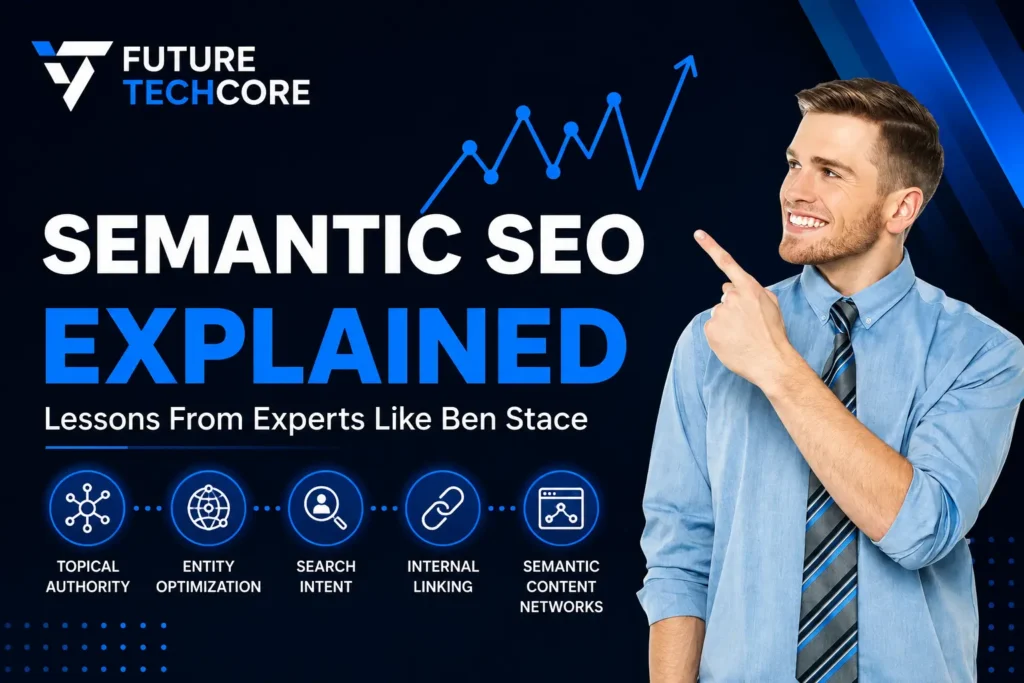
Industry experts such as Ben Stace have popularized techniques like topical mapping, entity optimization, and semantic content networks strategies that help websites become authoritative in their niche.
In this article, we’ll break down:
- What Semantic SEO is.
- Lessons from experts like Ben Stace.
What is Semantic SEO?
Semantic SEO is the process of optimizing your content so search engines understand its true meaning, not just the words on the page.
Instead of stuffing in exact-match keywords, Semantic SEO focuses on:
Entities:
Recognizable concepts like people, brands, places, and topics.
Relationships:
How those entities connect in a larger topic.
Search Intent:
Matching the content to what the user actually wants to know.
For example: Old SEO → “best coffee shop” repeated 10 times, Semantic SEO → Covers coffee types, brewing methods, café culture, reviews, and related concepts, all connected in a logical way.
Turn Data into Action
Lessons from Experts Like Ben Stace
1. Build Topical Maps
Ben Stace is known for creating topical authority using structured content maps. A topical map ensures your site covers all related subtopics, so Google sees you as a subject-matter authority.
Example: If your topic is “Cybersecurity,” your map would include encryption, phishing prevention, compliance laws, tools, and case studies.
2. Create Entity-Rich Content
Entity optimization means naming and connecting key concepts in your content. This includes mentioning industry leaders, tools, locations, statistics, and official definitions all recognized by Google’s Knowledge Graph.
3. Optimize for Search Intent
Ben Stace emphasizes that content should match the user’s intent:
- Informational → They want to learn.
- Transactional → They want to buy.
- Navigational → They want to go somewhere.
By aligning content with the correct intent, you improve both rankings and conversions.
4. Internal Linking for Authority
A strategic internal linking structure connects related pages so authority flows through your site. This is crucial in Semantic SEO because it helps Google understand topic hierarchy.
5. Use Semantic Content Networks
Instead of isolated articles, create a network of related content that supports each other. Ben Stace uses this to boost overall topic authority, making it harder for competitors to outrank you.
Seamless Integrations for Rapid Scaling
Why Semantic SEO is a Must in 2025
- Google’s algorithms now use AI and NLP to understand meaning, not just keywords.
- Voice search and AI chatbots rely heavily on semantic relevance.
- Websites with strong topical authority are rewarded with higher, more stable rankings.
By implementing Semantic SEO now, your business secures a future-proof SEO strategy.
Driving Growth in Sydney’s Auto Market?
Semantic SEO builds the foundation, but industry-specific execution drives the sales. If you’re ready to turn your dealership or automotive brand into a Sydney authority, let’s accelerate your digital presence.
Frequently Asked Questions (FAQs)
Who is Ben Stace in SEO?
Ben Stace is an industry expert known for his work on Semantic SEO, topical mapping, and entity-based content strategies.
What is Semantic SEO?
It’s the process of optimizing content based on meaning, relationships, and entities, not just keywords.
Is Semantic SEO better than traditional SEO?
Yes. It aligns with how Google’s AI understands content, providing better long-term ranking stability.
How does topical mapping work?
It involves structuring all related subtopics around a main subject to build topical authority.