

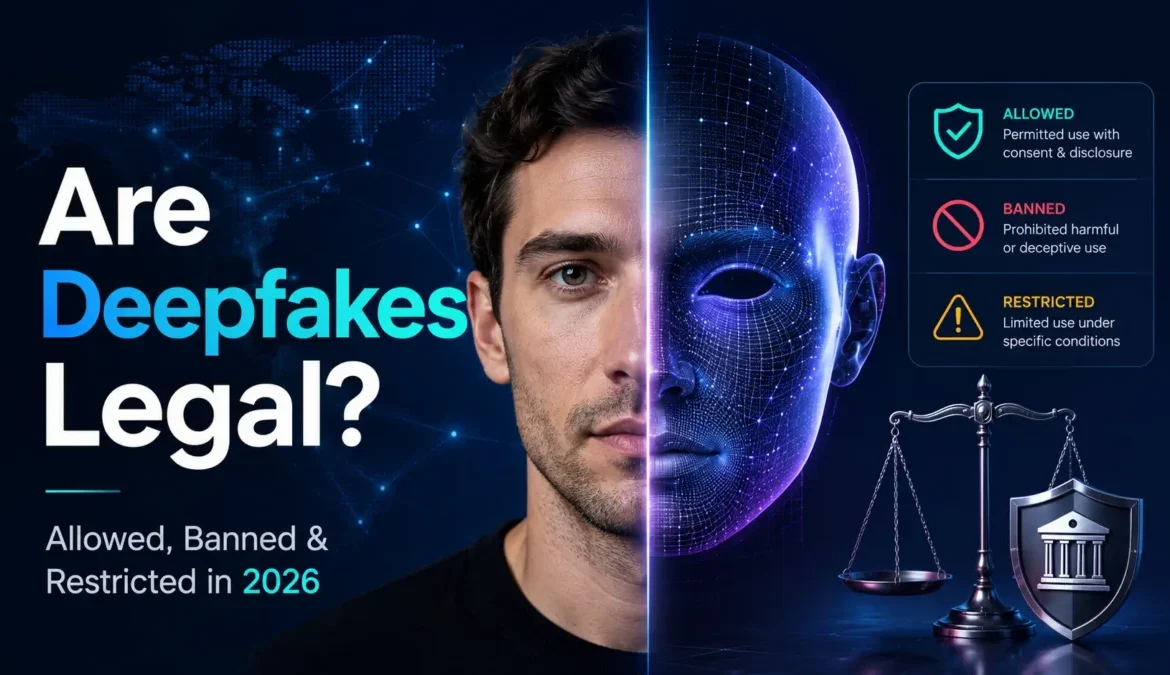
Deepfakes are not automatically illegal. In 2026, their legality usually depends on what the content shows, whether the person consented, how the deepfake is used, and which country’s laws apply. A clearly fictional or consensual deepfake may be legal, while deepfakes used for fraud, non-consensual intimate content, blackmail, harassment, election manipulation, or impersonation can trigger criminal or civil liability.
The important point is that most countries do not ban all deepfakes. Instead, they regulate specific harmful uses and, increasingly, require AI-generated content to be clearly labeled.
What Are Deepfakes?
Deepfakes are AI-generated or AI-manipulated images, videos, or audio that make a real person appear to say or do something that never actually happened. They are typically created using machine learning models that can imitate faces, voices, expressions, and movements.
For example, a deepfake could make a public figure appear to give a speech they never made, or clone someone’s voice to make it sound as if they said words they never actually recorded.
Are Deepfakes Legal or Illegal?
The simplest answer is: some are legal and some are not. A movie studio using AI to alter an actor’s appearance with permission is very different from someone using the same technology to create fake intimate images or impersonate a company executive in a financial scam.
That distinction is becoming central to deepfake laws worldwide.
| Deepfake Use | General Legal Position |
|---|---|
| Film, entertainment or VFX with permission | Usually legal |
| Satire or parody clearly presented as fictional | Often legal, subject to local law |
| Face or voice cloning with consent | Often legal |
| Fraud or financial impersonation | Usually illegal |
| Non-consensual intimate deepfakes | Illegal or specifically restricted in many jurisdictions |
| Deepfake child sexual abuse material | Illegal in many jurisdictions |
| Blackmail or sextortion using deepfakes | Illegal |
| Election deepfakes | Restricted in some countries and U.S. states |
| Unlabeled AI-generated content | May breach transparency rules in some jurisdictions |
There is no single global deepfake law, so the details can change considerably from one country to another.
When Does a Deepfake Become Illegal?
A deepfake usually becomes a legal problem because of what someone does with it, not simply because AI was used to create it.
1- Fraud and Impersonation
Using a cloned voice or manipulated video to deceive someone into sending money can fall under existing fraud laws. This matters because modern deepfakes are no longer limited to edited celebrity videos. AI-generated voices and faces can now be used in convincing impersonation attempts.
The same AI systems that improve automation across industries can create new risks when identity is involved. In financial technology, for example, AI in FinTech is increasingly used for fraud detection and verification, partly because digital financial systems have to distinguish legitimate users from sophisticated automated threats.
2- Non-Consensual Intimate Deepfakes
This is one of the areas where regulation has moved fastest. Creating or distributing fake sexual images of a real person without consent can now trigger specific criminal offences in several jurisdictions.
In the UK, police guidance says it is illegal to create, request the creation of, share, or threaten to share certain fake intimate images without permission.
The UK’s Crime and Policing Act 2026 goes further by criminalising the making or supplying of tools intended for generating purported intimate images, subject to defined defences.
3- Child Sexual Abuse Material
Deepfake technology does not create a legal loophole for sexual images involving children. UK police guidance, for example, states that indecent pseudo-photographs and videos of people under 18 can be illegal even when they are digitally created rather than real photographs.
Similar child-protection principles exist in many other jurisdictions.
4- Blackmail, Harassment and Sextortion
A fake image or recording can also become evidence of another crime. Using a deepfake to threaten someone, demand money, cause repeated distress, or pressure them into doing something can fall under laws covering blackmailing, harassment, stalking, sextortion, and false communication.
Deepfake technology changes how convincing the material looks, but many of the underlying offences already existed before generative AI.
Deepfake Laws in the United States
The United States does not have one law banning all deepfakes. Instead, regulation is a combination of federal laws and state-level rules covering areas such as intimate imagery, elections, fraud, publicity rights and impersonation.
One major federal development is the TAKE IT DOWN Act, which targets certain non-consensual intimate visual depictions, including digital forgeries.
The law is no longer theoretical. In June 2026, the U.S. Department of Justice announced the seizure of domains allegedly distributing large volumes of non-consensual deepfake sexual images under the new law.
State laws add another layer. Some states regulate deceptive political deepfakes around elections, while others focus on intimate imagery or digital impersonation.
So, asking whether a deepfake is legal in the U.S. requires looking at both the type of content and the applicable state law.
Deepfake Laws in the European Union
The European Union takes a different approach. Rather than simply banning deepfakes, the EU AI Act introduces transparency requirements for certain AI-generated or manipulated content.
Article 50 of the AI Act applies from 2 August 2026. The European Commission says deepfakes must be disclosed in a clear way when they fall within the provision, while providers of generative AI systems also face machine-readable marking requirements for generated or manipulated outputs.
This creates an important distinction:
A deepfake can potentially be lawful content but still require disclosure.
For example, artistic, fictional and satirical content can receive more flexible treatment, but the disclosure obligation does not simply disappear in every case. The Commission’s guidance specifically considers how audience expectations and context affect the requirement.
The EU’s approach shows how deepfake regulation is expanding beyond criminal harm into AI transparency and provenance.
Deepfake Laws in the United Kingdom
The UK has strengthened its position considerably. Deepfakes can already fall under laws dealing with fraud, harassment, blackmail, copyright and intimate image abuse. Police guidance explicitly says deepfakes are not always illegal, but lists several circumstances in which they can form part of criminal conduct.
Recent legislation has added specific rules around intimate deepfakes. The Data (Use and Access) Act 2025 created offences relating to creating or requesting the creation of purported intimate images without consent.
The Crime and Policing Act 2026 then introduced additional offences targeting tools and services designed to facilitate the creation of such images, alongside faster takedown duties for certain online services.
So the UK’s legal position is now far more specific than simply applying old privacy or defamation rules to AI-generated content.
What About China, India, Australia and Other Countries?
Deepfake regulation is developing differently around the world. Some countries focus heavily on content labeling and platform responsibility, while others use existing laws covering fraud, privacy, elections, defamation, pornography, or impersonation.
- China has been an early mover on synthetic-media and algorithmic content rules, with requirements around labeling and responsible use.
- Australia has strengthened laws around digitally created sexual material and online harm.
- India relies on a combination of information-technology, criminal, privacy and platform rules, with policymakers continuing to respond to AI-generated impersonation and misinformation.
- Countries including South Korea and Singapore have also introduced or applied rules relevant to harmful synthetic media.
This is why a global yes-or-no answer is misleading. Deepfake laws worldwide in 2026 are increasingly specific to the type of harm involved.
Are Political Deepfakes Illegal?
Not everywhere. Political deepfakes sit in one of the most complicated legal areas because lawmakers have to balance election integrity against freedom of expression, parody and political speech.
Some jurisdictions restrict deceptive synthetic media close to elections or require disclosures when content has been manipulated.
Other countries rely more heavily on broader election, defamation or misinformation rules.
A clearly satirical political video may therefore be treated differently from a realistic fake video deliberately presented as genuine immediately before an election.
The key factors are often:
- whether the content is deceptive;
- whether it is disclosed as AI-generated;
- when it is published;
- whether it targets an election;
- whether local election law specifically covers synthetic media.
Is Creating a Deepfake Illegal if You Never Share It?
Not necessarily, but this is an area where the law is changing quickly. Historically, many laws focused on distribution because harm often occurred when manipulated content was published.
Newer laws increasingly target creation itself in specific situations. The UK is a good example. Its legislation now criminalises creating or requesting certain non-consensual intimate deepfakes even before wider distribution is considered.
That means the old assumption that “it is legal as long as I don’t post it” is no longer reliable.
Do Deepfakes Have to Be Labeled?
In some places, yes. The clearest current example is the European Union.
From 2 August 2026, Article 50 of the AI Act introduces transparency obligations covering deepfakes and other AI-generated content. The Commission says deployers covered by the rules must clearly disclose deepfakes, while providers must support detection through machine-readable marking.
This is important because labeling laws deal with a different problem from criminal bans. A deepfake might not be harmful or illegal in itself, but failing to disclose that it was artificially generated can still create a compliance issue.
Can Deepfakes Violate Copyright or Personality Rights?
Yes. Deepfakes can also create legal problems without involving criminal law.
For example, a deepfake may reproduce copyrighted photographs, performances, recordings or other protected material. Police.uk notes that manipulated content can potentially infringe copyright, performers’ rights, and moral rights depending on how protected material is used.
Other disputes can involve:
- defamation;
- privacy;
- publicity or likeness rights;
- trademark misuse;
- unauthorized voice cloning.
These issues become especially important when someone’s face, voice or reputation is used commercially.
Are Deepfakes Safe to Create for Entertainment?
They can be, but consent and transparency matter. Using deepfake-style technology for:
- visual effects;
- parody;
- clearly fictional content;
- accessibility;
- dubbing;
- entertainment with permission
is very different from pretending a real person did or said something harmful.
A practical rule is simple:
The more realistic the content is, the more important consent, context, disclosure and intended use become.
Creating a harmless fictional effect is not the same legal situation as impersonating a real person to influence voters or steal money.
How We Evaluated Current Deepfake Laws
Because deepfake regulation is changing quickly, this article focuses on current government and regulatory material rather than treating older blog summaries as definitive legal sources.
Future Tech Core‘s editorial process prioritizes primary documentation and makes a distinction between confirmed rules and broader interpretation. That approach is especially important for AI regulation, where laws can change between updates. Our editorial policy explains how sourcing, verification and corrections are handled across the site.
The information here is a general technology and legal overview, not individual legal advice.
Final Verdict: Are Deepfakes Legal in 2026?
Yes, some deepfakes are legal, but many harmful uses are banned or restricted. Deepfake technology itself is not universally illegal. The legal risk usually comes from lack of consent, deception, harm or failure to comply with transparency rules.
A consensual movie effect may be perfectly lawful. A non-consensual sexual deepfake, fraudulent voice clone, blackmail attempt, deceptive election video, or undisclosed synthetic media can fall under very different rules.
The trend in 2026 is clear: governments are moving away from treating deepfakes as one category and toward regulating specific harms, consent and transparency.